First Home Buyer Budget Template
Download a free first home buyer budget workbook for Australia. Plan your deposit, purchase costs and savings with five sheets and illustrative examples.
Free XLSX. No email required.
Inside the workbook
- Dashboard
- Cost Planner
- Savings Tracker
- State Costs
- Instructions
For Australian first home buyers planning upfront costs. Edit the example inputs and confirm transaction costs with your lender and conveyancer.
What this budget template covers
Buying your first home in Australia involves more than saving a 20% deposit. There are conveyancing fees, building inspections, stamp duty (or stamp duty concessions), LMI, utility connections, moving costs, and settlement adjustments for council rates and other outgoings. Replace the workbook examples with quotes and eligibility checks for your purchase.
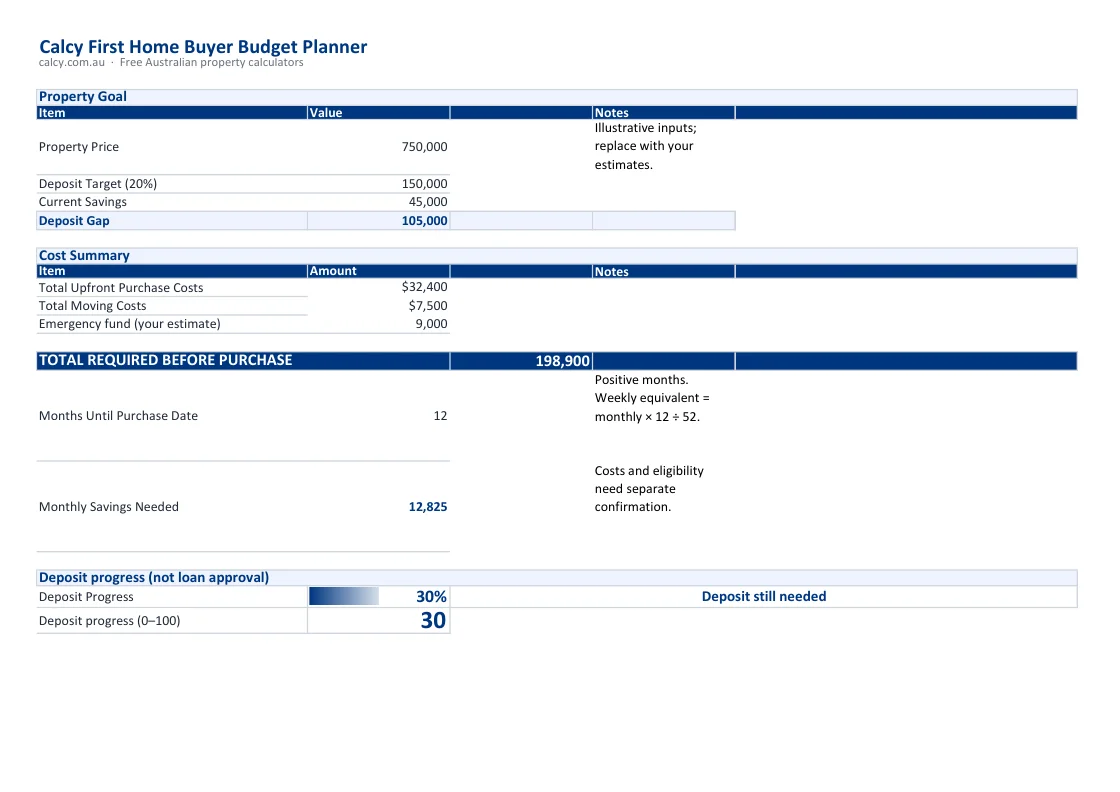
This Excel workbook covers common purchase-cost categories, with illustrative inputs for a $750,000 purchase. Replace the Dashboard inputs and Cost Planner amounts with your own estimates, and update the Savings Tracker as you save. Confirm any extra costs for your transaction with your conveyancer and lender.
How to use the template
Three simple steps:
- Download the Excel workbook — click the download button below to get the spreadsheet. Use an application that supports XLSX formulas and check the results after opening.
- Replace the example values with your own situation. Use the stamp duty calculator, LMI calculator, and borrowing power calculator to build estimates for your state and loan size. Confirm LMI with your lender.
- Review your total — the 'TOTAL REQUIRED BEFORE PURCHASE' row shows how much you need before settlement. The 'Monthly Savings Needed' row helps you assess whether you're on track or need to adjust your savings plan or property price target.
Common upfront costs for Australian first home buyers
| Cost item | Budget input | Notes |
|---|---|---|
| Stamp duty | Official duty estimate | Property type, state rules and personal eligibility matter |
| Lender's Mortgage Insurance | Lender quote | Confirm whether it applies and how it is paid |
| Conveyancing / legal fees | Conveyancer quote | Confirm scope, disbursements and settlement charges |
| Building & pest inspection | Inspector quote | Confirm suitable inspections for the property |
| Loan application / valuation fee | Lender fee schedule | Check actual product terms and any waiver |
| Moving costs | Moving quote | Professional movers + truck + boxes |
| Council & water rate adjustment | Settlement statement | Allow for adjustments shown on the settlement statement |
| Emergency fund | Your chosen buffer | Keep this after settlement — not spent on purchase |
Pair with the right calculators
An accurate budget is only as good as the numbers you put in it. Use the mortgage calculator to estimate repayments at different loan sizes and rates, the stamp duty calculator for an estimate of your state's duty, and the borrowing power calculator to explore borrowing scenarios; lender approval requires a separate assessment. If you are saving with a partner, the loan comparison tool helps you compare loan options side by side.
Plan repayments after settlement
After organising upfront buying costs, use the Mortgage Repayment Planner to map ongoing principal-and-interest repayments. Keep the purchase budget separate from the loan schedule.
Track the deposit separately
Use the Deposit Savings Tracker to separate money already saved from planned monthly and one-off contributions. Keep duty and other purchase costs in this Budget Planner.
Assumptions, limitations and method
The workbook totals the buying costs and savings you enter. Its $750,000 purchase example is illustrative, not a price forecast or a lender quote. Replace example costs, keep a separate cash buffer and check duty concessions and lender fees for your transaction. It does not determine loan approval or personal eligibility.
Use the Instructions sheet, confirm spreadsheet recalculation and compare the Dashboard with the Cost Planner and Savings Tracker. Read Calcy’s methodology for the related calculators. No workbook data is submitted when you download.
Optional email updates
Get new Calcy tools and home-buying updates
Free calculators, spreadsheets and practical Australian home-buying resources. Unsubscribe anytime. Confirm your address by email before receiving updates. Downloading never signs you up.
Frequently asked questions
How much do I need before I can buy my first home?
Add your chosen deposit target, applicable duty, lender and legal fees, inspections, moving costs and a cash buffer, then subtract available savings. The workbook uses an illustrative 20% deposit target; this is a planning assumption, not a universal lending requirement. Enter your own quotes and eligibility-specific duty.
What is LMI and how does it affect my budget?
Lenders Mortgage Insurance protects the lender and may apply to a lower-deposit loan. Its price and any waiver depend on the lender, insurer and loan. If your lender allows the premium to be added to the loan, interest may accrue on it. Use an indicative calculation for planning and obtain a lender quote before committing.
Should I include stamp duty in my purchase budget?
Yes — stamp duty is one of the biggest upfront costs and varies by state and property price. Eligible NSW first-home purchases are exempt to $800,000; eligible Victorian purchases are exempt to $600,000 with a concession to $750,000. Personal and transaction conditions apply. Use the stamp duty calculator for your state to estimate duty and confirm it with your revenue office and add it to your budget template.
What are common hidden costs first home buyers miss?
Other costs to consider include council rate adjustments (the seller pre-pays and you reimburse them at settlement), strata report fees for apartments, utility connection fees, and the gap between your pre-approval amount and actual borrowing capacity. Allow for moving costs and initial furniture purchases. Add any transaction-specific costs to the template.
Can I use the First Home Super Saver Scheme (FHSSS) for my deposit?
Eligible voluntary super contributions may be released through the first home super saver scheme. Contribution limits, tax, determination and release requirements apply. Check the ATO rules before planning a release, and count only funds that will actually be available when needed. Do not count an unreleased super balance as cash already saved.
How do I know if I qualify for first home buyer grants?
Grant availability and eligibility differ by jurisdiction; the ACT has no FHOG. NSW offers $10,000 for eligible completed new-home purchases up to $600,000, with a separate $750,000 combined land-and-build cap. QLD offers $30,000 for eligible new homes valued below $750,000 under its extended boost. Confirm eligibility and payment timing with the revenue office before treating a grant as settlement funds.
General information and estimates, not personal financial advice. Check assumptions and official sources before making decisions.